When we think of crocodilians, the image that typically springs to mind is one of ancient, armored predators lurking in murky waters, embodying a primordial sense of menace. This fearsome reputation, cemented by countless documentaries and films, paints them as cold-blooded killing machines, relics of a bygone era with a singular focus on survival through brute force. However, this long-held caricature is a profound oversimplification, obscuring a complex and surprisingly tender side to their nature. A growing body of scientific research is peeling back the scales to reveal a world of intricate social behaviors, sophisticated communication, and, most astonishingly, a depth of parental care that rivals that of many birds and mammals.
The journey of crocodilian parental devotion begins not with the hatchlings, but with the mother’s meticulous preparation even before her offspring exist. Unlike many reptiles that simply deposit their eggs and abandon them to fate, female crocodiles and alligators are consummate architects and guardians. The process is initiated with the careful construction of a nest. Depending on the species and habitat, this can be a mound nest, built from a mixture of soil, mud, and decaying vegetation, or a hole nest dug into a sandy bank. The choice of material is not arbitrary; the composting vegetation in a mound nest generates significant metabolic heat, effectively acting as a natural incubator, regulating the temperature critical for the eggs' development.
This temperature regulation is far more than a simple matter of warmth; it plays a pivotal role in determining the sex of the developing embryos—a phenomenon known as temperature-dependent sex determination. Within a specific temperature range, the clutch will yield a mix of males and females. However, skew slightly warmer or cooler, and the entire brood will emerge as a single sex. The mother actively maintains this delicate thermal balance, often by staying near the nest, adding or removing nesting material, and even urinating on it to cool it down during excessively hot days. For weeks, sometimes months, she remains on high alert, fiercely defending the precious mound from any potential intruders, be they raccoons, monitor lizards, or even other crocodiles.
The pinnacle of this maternal vigil arrives when the eggs are ready to hatch. The babies inside the eggs begin to emit a series of high-pitched, pre-hatching calls. These are not random sounds; they are a deliberate signal, a collective plea for help. To the human ear, it might sound like simple chirping, but to the mother, it is a clear and urgent communication. This vocalization triggers a deeply ingrained response. She hears their calls and immediately springs into action, her immense power now used not for hunting, but for nurturing.
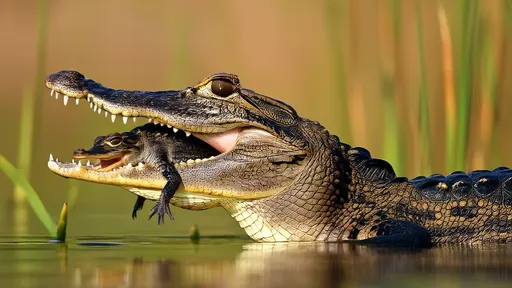
With astonishing delicacy given her formidable anatomy, the mother begins to excavate the nest. Using her teeth and her powerful snout, she carefully uncovers the eggs, avoiding crushing them with a precision that belies her size. She will often gently roll the eggs in her mouth, helping to fracture the shell and facilitate the hatching process for any struggling neonates. This act of assisted hatching is a critical juncture, ensuring the entire clutch emerges together and safely. To witness a three-meter-long predator, an animal capable of spectacular violence, cradle a tiny, struggling hatchling in its jaws with the utmost care is a profoundly moving spectacle that shatters simplistic stereotypes.
But her duties do not end at the nest's edge. The world remains an incredibly dangerous place for a hatchling crocodilian, no larger than a human hand. Birds of prey, large fish, and other predators view them as easy meals. Recognizing this vulnerability, the mother exhibits what can only be described as extended postnatal care. She will often gently gather the chirping hatchlings in her mouth, their tiny bodies safely cradled within her mighty jaws, and transport them to a pre-selected nursery area—typically a shallow, protected body of water rich in food and with ample hiding spots among aquatic vegetation.
This nursery period can last for weeks, and in some species like the Nile crocodile, for up to two years. During this time, the mother remains a constant, vigilant presence. She is not a hands-off supervisor; she is an active protector. She will aggressively chase off any threat that approaches her crèche. Furthermore, evidence suggests she continues to communicate with her young through a repertoire of low-frequency grunts and rumbles, calls that may serve to keep the group cohesive or signal danger. The hatchlings, in turn, respond to her calls, creating a continuous audio link between mother and offspring.
The implications of this complex behavior are revolutionary for our understanding of reptile cognition and social evolution. It demonstrates that parental investment—a term once reserved for warm-blooded creatures—is very much a feature of the reptilian world. This care is energetically costly for the mother; the time spent guarding the nest and young is time not spent feeding, and it exposes her to her own set of risks. The fact that this strategy has been evolutionarily conserved for millions of years indicates that the benefits—increased survival rates of genetically related offspring—significantly outweigh the costs.
This challenges the very definition of what we consider "advanced" or "instinctual" behavior. The nuanced response to pre-hatching calls, the coordinated transport of young, and the long-term guarding all point towards a level of cognitive processing, memory, and decision-making that is far more sophisticated than a simple, hardwired instinct. It suggests a capacity for bonding and recognition that forces us to reconsider the emotional and mental lives of these ancient creatures.
Ultimately, the story of crocodilian parental care is a powerful reminder of the dangers of anthropomorphism and its opposite—the refusal to acknowledge complexity in animals that do not resemble us. Their world is not one of simple, cold-blooded brutality. It is a world of subtle sounds, of calculated risks, of fierce protection, and of a quiet, determined gentleness that ensures the survival of the next generation. By looking past the teeth and the armor, we discover a narrative of care that is every bit as compelling as any found in the animal kingdom, a testament to the fact that tenderness can, and does, exist in the most unexpected of places.

By /Aug 21, 2025
By /Aug 21, 2025
By /Aug 21, 2025

By /Aug 21, 2025
By /Aug 21, 2025
By /Aug 21, 2025

By /Aug 21, 2025

By /Aug 21, 2025

By /Aug 21, 2025
By /Aug 21, 2025

By /Aug 21, 2025

By /Aug 21, 2025
By /Aug 21, 2025

By /Aug 21, 2025

By /Aug 21, 2025

By /Aug 21, 2025

By /Aug 21, 2025

By /Aug 21, 2025

By /Aug 21, 2025

By /Aug 21, 2025
