In the vast and varied tapestry of the animal kingdom, few anatomical features are as iconic or as functionally remarkable as the marsupial pouch. This extraordinary structure, a hallmark of kangaroos, koalas, wallabies, and their relatives, is far more than a simple pocket; it is a highly sophisticated, mobile nursery that has been perfected over millions of years of evolution. It represents a radical and successful alternative to the placental reproductive strategy employed by most other mammals, offering a fascinating glimpse into nature's ingenuity.
The journey of a marsupial begins in a state of profound vulnerability. After a remarkably short gestation period—often mere weeks—the embryonic newborn, called a neonate, is born. It is barely formed, blind, deaf, and only a few centimeters long, resembling a pink, gelatinous bean more than a finished animal. Its hind limbs are mere buds, but its forelimbs are disproportionately strong and equipped with claws. This is because its first and most critical mission is a monumental climb. Instinctively, the neonate must haul itself from the birth canal, through its mother's fur, and into the sanctuary of her pouch. This treacherous journey, driven by an ancient imperative, is one of the most perilous and dramatic commencements to life in the entire natural world.
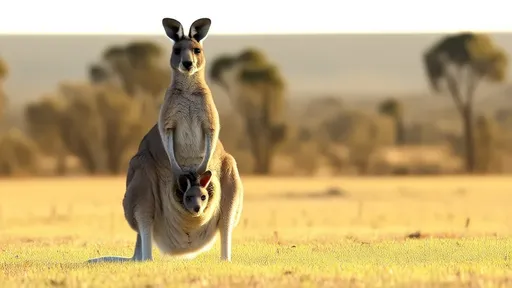
Upon successfully reaching the pouch, the neonate's real development begins. It immediately latches onto one of the mother's teats, which then swells in its mouth, effectively fusing them together to ensure a constant supply of milk. The pouch itself is not a passive holding area; it is a controlled environment. The mother possesses muscles to tighten the opening, sealing her precious cargo safely inside during high-speed hops or escapes from predators. Internally, the skin is rich with sweat glands and, in some species, antimicrobial properties, helping to keep the developing young clean and free from infection. For the joey, this warm, dark, and secure space becomes its entire universe—a place to sleep, feed, and grow without exposure to the external dangers its mother faces daily.
The role of the mother in this arrangement is one of immense biological investment and fine-tuned control. She is not merely carrying offspring; she is operating a complete life-support system. A female kangaroo, for instance, exhibits a phenomenon known as embryonic diapause. She can mate again just days after giving birth, conceiving a new embryo that remains in a state of suspended animation until the current joey either leaves the pouch or dies. Furthermore, she can produce two different types of milk simultaneously from separate teats—one rich in carbohydrates for an older joey that occasionally leaves the pouch, and another full of complex proteins and fats for the tiny neonate still permanently attached inside. This allows her to support offspring at different stages of development, a incredible feat of physiological multitasking.
As the joey matures over several months, its relationship with the pouch evolves. It begins to tentatively peek out, then later to briefly exit, hopping back in at the first sign of danger or when it needs to feed. This phase is a careful ballet of increasing independence, with the pouch serving as a secure home base. The mother continues to groom her offspring inside and meticulously clean the pouch itself, maintaining its hygienic standards. Eventually, the growing juvenile becomes too large to fit inside comfortably. It is weaned off milk and must face the world on its own, vacating the pouch for good. If the mother has a dormant embryo waiting, it will now reactivate and begin its own development, continuing the cycle.
The evolutionary advantages of this "mobile托儿所" strategy are significant, particularly in the challenging and often unpredictable environments of Australia where many marsupials evolved. A short gestation period means the mother is not weighed down by a large litter during pregnancy, allowing for greater mobility to forage and flee. In times of drought or famine, she can simply pause the development of an embryo in diapause, conserving her own energy and resources until conditions improve. The external development of the young, while risky initially, allows the mother to cut her losses early if a newborn fails to make it to the pouch, rather than investing heavily in a long internal pregnancy. It is a reproductive model built for resilience and adaptability.
Ultimately, the marsupial pouch stands as a testament to the power of evolutionary innovation. It is a complex, dynamic organ that provides protection, nutrition, and a controlled microclimate, all while granting the mother unparalleled mobility. This strategy has allowed marsupials to not just survive, but to thrive and diversify into a wide array of ecological niches. From the powerful red kangaroo bounding across the outback to the solitary koala nestled in a eucalyptus tree, the pouch remains their defining biological signature—a perfect, portable cradle that has nurtured generations for millennia.

By /Aug 21, 2025
By /Aug 21, 2025

By /Aug 21, 2025

By /Aug 21, 2025
By /Aug 21, 2025
By /Aug 21, 2025

By /Aug 21, 2025

By /Aug 21, 2025

By /Aug 21, 2025
By /Aug 21, 2025
By /Aug 21, 2025
By /Aug 21, 2025

By /Aug 21, 2025

By /Aug 21, 2025
By /Aug 21, 2025
By /Aug 21, 2025

By /Aug 21, 2025
By /Aug 21, 2025
By /Aug 21, 2025

By /Aug 21, 2025
