In the quiet hours before dawn, a soft rustle stirs the reeds along the wetlands of Siberia. A flock of bar-tailed godwits, having feasted through the brief Arctic summer, lifts into the sky. Their journey, one of the most extraordinary in the natural world, will take them non-stop across the vast expanse of the Pacific Ocean to the shores of New Zealand. They are not alone. Across the globe, billions of birds embark on similar epic voyages, tracing ancient pathways in the sky that weave across continents and oceans. These are the migrants, and their survival hinges on a fragile, interconnected chain of habitats that knows no political borders. Their enduring journey has, in turn, inspired one of humanity's most remarkable conservation endeavors: the transnational network for migratory bird protection, a silent pact among nations to guard these feathered travelers.
The scale of avian migration is perhaps the greatest spectacle of the natural world, a rhythmic pulse of life that has continued for millennia. It is a complex tapestry of movement, driven by the immutable forces of seasons, food availability, and breeding instincts. From the tiny ruby-throated hummingbird crossing the Gulf of Mexico to the mighty albatross circling the Antarctic, each species follows its own inherited map. Yet, these aerial highways are increasingly fraught with peril. The very nature of their journey—spanning countless countries and jurisdictions—makes them vulnerable to a cascading series of threats. The loss of a single critical stopover site, a wetland drained for agriculture or a forest cleared for development, can unravel the entire migratory chain for a population. It is a classic tragedy of the commons, where no single nation can shoulder the responsibility for a resource that belongs to all.
Recognizing this existential challenge, the late 20th century saw the birth of a new paradigm in conservation. The foundational stone of this international effort is the Convention on the Conservation of Migratory Species of Wild Animals (CMS), often called the Bonn Convention. Established under the auspices of the United Nations Environment Programme, the CMS provides a global platform for the range states—the countries these animals pass through—to agree on coordinated protection measures. It is a framework rather than a rigid set of rules, designed to foster cooperation and create legally binding agreements tailored to specific regions or species. The CMS acknowledges that the fate of a bird that breeds in Russia, winters in India, and transits through China is a shared responsibility. It is the diplomatic cornerstone upon which the entire network is built.
This framework comes to life through a series of specialized agreements and partnerships. Among the most significant for birds is the Agreement on the Conservation of African-Eurasian Migratory Waterbirds (AEWA). This ambitious treaty brings together countries from northern Canada and Russia to southern Africa, encompassing the entire migratory flyway. Parties to AEWA commit to a detailed action plan: protecting key wetlands, managing hunting sustainably, mitigating threats like power lines and wind turbines, and conducting joint research and monitoring. Similarly, in the Americas, partnerships like the Western Hemisphere Shorebird Reserve Network (WHSRN) identify and protect a chain of critical sites. A beach in Delaware Bay, a salt marsh in Argentina, and a mudflat in Alaska might be thousands of miles apart, but under this network, they are recognized as interconnected nodes essential for survival.
On the ground, the work is as diverse as the landscapes the birds traverse. In the mudflats of the Yellow Sea, a critical stopover for millions of shorebirds flying from Siberia to Australia, conservationists from China, South Korea, and other nations are racing against time. Satellite tracking has revealed the astounding non-stop flights these birds undertake, making the energy-rich mollusks and worms of these wetlands a literal lifeline. International pressure and collaboration have led to the designation of new protected areas and the shelving of destructive coastal development projects. Meanwhile, along the flyways of Europe and Africa, a different battle is fought against illegal killing. Millions of birds are illegally trapped or shot each year. In response, coalitions of NGOs, government agencies, and local communities are working together to enforce laws, promote sustainable alternatives, and run public awareness campaigns, transforming former hunters into guardians of the sky.
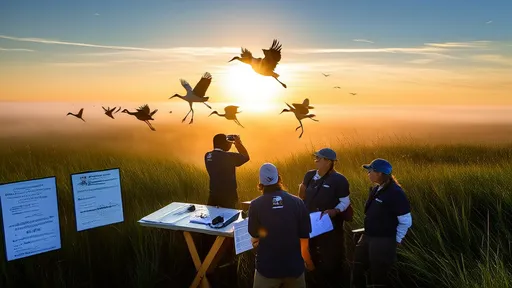
Science is the silent engine powering this entire network. You cannot protect what you do not understand. The once-mysterious routes of migrants have been illuminated by tiny, sophisticated tracking devices—geolocators, satellite tags, and radio transmitters that weigh less than a coin. The data they stream back is revolutionary, revealing precise migration paths, timing, and the location of previously unknown stopover sites. This intelligence allows conservationists to pinpoint exactly where to focus their efforts. Furthermore, decades of standardized bird counting by thousands of dedicated volunteers across continents provide the vital long-term data needed to detect population trends. A decline in numbers of a specific warbler in Europe might be traced back to habitat loss at a specific site in West Africa, triggering a targeted international response.
Perhaps the most profound aspect of this network is its ability to forge peace and build bridges between human communities. In a powerful display of environmental diplomacy, conservation projects have created neutral ground for dialogue between nations with otherwise strained relations. The protection of cranes has fostered cooperation between North and South Korea in the Demilitarized Zone. In the Middle East, Jordan, Israel, and the Palestinian Authority have collaborated on projects to protect soaring birds along the Great Rift Valley flyway, a natural corridor that also happens to be a historical crossroads of conflict. These birds, oblivious to the lines drawn on maps, become ambassadors for a shared natural heritage, reminding us that some bonds transcend politics.
Despite these monumental efforts, the network faces relentless headwinds. Climate change is shifting the very fabric of the ecosystems migrants depend on. Seasons are falling out of sync; a bird may arrive on its breeding grounds only to find its insect food source has already peaked and disappeared. The rampant destruction of habitats, particularly wetlands and forests, continues at an alarming rate. The challenges of funding, political will, and enforcement in remote areas are constant. The network is not a perfect shield; it is a desperate, often under-resourced, holding action against a tide of ecological loss. Yet, its very existence is a testament to a growing global consciousness.
The story of migratory bird conservation is a story of connection. It connects the Arctic tundra to African savannas, and Siberian taiga to Australasian beaches. More importantly, it connects people across cultures and nations through a common cause. The farmer in Spain who leaves stubble in his fields for foraging cranes, the student in Ghana who rallies against the illegal bird trade, the scientist in Alaska who carefully attaches a tracker to a godwit, and the policymaker in Bonn negotiating a new agreement—they are all threads in this vast, invisible net stretched across the sky. It is a net woven not from rope, but from shared responsibility, scientific curiosity, and a deep, enduring awe for the incredible journey of the feathered beings that, twice a year, stitch our world together. Their flight is a reminder that nature does not recognize our borders, and their protection is our collective, transnational duty.

By /Aug 21, 2025
By /Aug 21, 2025

By /Aug 21, 2025

By /Aug 21, 2025

By /Aug 21, 2025

By /Aug 21, 2025

By /Aug 21, 2025

By /Aug 21, 2025

By /Aug 21, 2025

By /Aug 21, 2025

By /Aug 21, 2025

By /Aug 21, 2025
By /Aug 21, 2025

By /Aug 21, 2025
By /Aug 21, 2025
By /Aug 21, 2025
By /Aug 21, 2025
By /Aug 21, 2025
By /Aug 21, 2025
By /Aug 21, 2025
