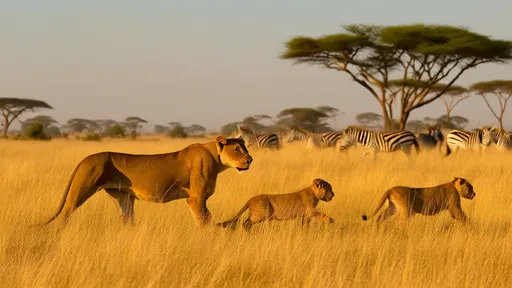
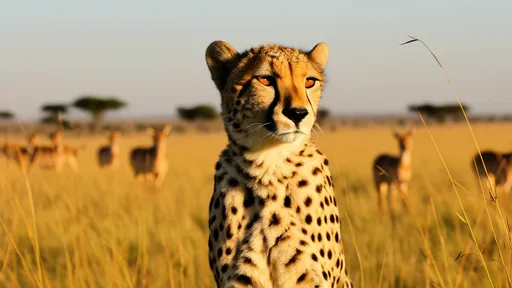
In the dense undergrowth of a temperate forest, a faint rustle betrays movement where all seems still. A mother bobcat pauses, one paw suspended mid-step, her gaze locked on the disturbance. Behind her, two clumsy kittens mirror her posture with comical imprecision, their oversized paws sinking into the soft earth. This silent tableau is not merely a hunt; it is a classroom. Across the wild felid world, from the sprawling savannas where lion prides reign to the solitary stealth of snow leopards on high cliffs, the transmission of hunting prowess from one generation to the next is a nuanced and critical education. It is a curriculum written in instinct, refined by observation, and tested in the unforgiving examination of survival.
The pedagogy of predation begins not with action, but with profound passivity. For weeks, the offspring are mere spectators, their world defined by the den or the dense thicket that serves as a nursery. Their mother’s comings and goings are their first lessons. She returns, her muzzle often bloodied, carrying not just food but the scent of the hunt—the musky odor of a rabbit, the metallic tang of a rodent. She regurgitates meat, and in that act, she does more than feed them; she intimately associates her presence, their safety, and their satiation with the product of a successful kill. The kittens learn to recognize the smell of death as the precursor to life, a fundamental rewiring of their nascent understanding of the world.
As their coordination improves and their curiosity outweighs their caution, the kittens are led on short excursions to the edges of their mother's territory. These initial field trips are less about hunting and more about sensory education. The mother will often stop, her body tensing at a scent mark left by a rival or the distant call of prey. The kittens, tumbling over each other, learn to read her body language—the flick of an ear, the twitch of her tail, the low, almost inaudible growl. They are learning the map of their world not through sight, but through smell and sound, and through the reactions of their primary teacher. A dropped feather, a scattered patch of fur from a past kill, a discarded snake skin—all become tactile textbooks.
The transition from observer to participant is gradual and meticulously managed by the mother. The first active lesson is often the most universal: the stalk. The mother will identify a simple, low-risk target—a grasshopper, a distracted lizard, a slow-moving beetle. She will drop into a classic stalking crouch, her body low to the ground, muscles coiled like springs. She demonstrates the painstakingly slow, deliberate placement of each paw, the need for absolute silence, and the control of breath. The kittens, buzzing with excitement, will attempt to mimic her, usually with disastrously noisy results. She tolerates these failures, sometimes even aborting her own stalk to nuzzle or correct them, physically repositioning a clumsy paw. Repetition is key. This single skill is drilled for days, sometimes weeks, on increasingly elusive insects, then small rodents, until the movement becomes second nature.
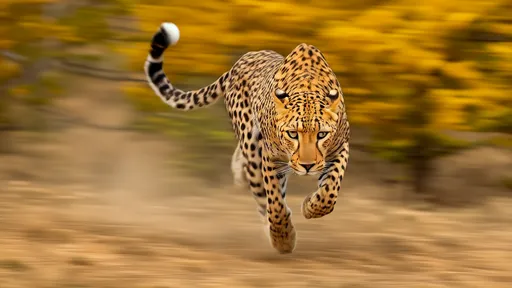
The pounce, the culmination of the stalk, is a lesson in physics and biology. The mother demonstrates the powerful launch from the hind legs, the trajectory through the air, and the critical landing with forepaws pinning the prey. She will often catch a mouse and, instead of killing it immediately, release it slightly injured or dazed right in front of her offspring. This "catch-and-release" teaching method is a high-stakes simulation. It forces the kittens to react, to practice their own pouncing technique on a moving, albeit compromised, target. The mother watches closely, ready to intervene if the prey escapes or, more critically, if it turns to fight. These sessions are frenetic, filled with missed leaps and startled squeaks, but they are essential for developing the coordination, timing, and accuracy required for a clean kill.
Perhaps the most complex lesson is the final one: the kill bite. Delivering a swift, merciful, and energy-efficient death is a technical skill. Prey species have different anatomies; the precise placement of teeth to sever the spinal cord of a rabbit is different from the suffocating throat clamp used on larger prey or the skull bite for a rodent. Mothers teach this through demonstration and guided practice. She will make a kill and allow the kittens to investigate the carcass, to smell the scent of death and see the fatal wound. As they graduate to larger prey, she may hold the struggling animal still, vocalizing with a specific chuffing sound, almost guiding their jaws to the correct spot on the neck. An incorrect bite wastes energy, prolongs suffering, and risks injury to the young hunter from teeth, claws, or hooves. This lesson is one of lethal efficiency.
The role of play in this entire process cannot be overstated. The mock fights between siblings, the pouncing on leaves blowing in the wind, the frantic chasing of their own tails—all these seemingly frivolous activities are vital exercises. They build muscle, sharpen reflexes, hone coordination, and deepen the bond between littermates that will be crucial for cooperative hunting in social species like lions. For a solitary mother, this play also keeps the kittens occupied and safe near the den while she is away hunting. She often returns and initiates play herself, a low-risk way to test their reflexes and aggression levels.
Ultimately, the mother's role evolves from teacher to evaluator. She begins to withhold food, returning to the den without having hunted, vocalizing impatiently to spur the kittens into action. She leads them to hunting grounds and then steps back, observing as they try to integrate their isolated skills into a seamless sequence of stalk, pounce, and kill. Their failures are met with hunger; their successes are met with shared consumption and, perhaps, a gentle grooming session—the wild felid equivalent of full marks. This period of tough love is the final exam. The young must prove not only technical competency but also the strategic thinking to select appropriate prey, the patience to abort a failed stalk, and the awareness to avoid danger.
This intricate educational journey, observed in the wild from tigers to servals, highlights a stunning depth of parental investment in the animal kingdom. It is a blend of innate programming and adaptive learning, a slow transfer of wisdom that has been perfected over millennia. The survival of the species hinges on this knowledge being successfully passed down. When a young mountain lion finally brings down its first deer alone, miles from its mother's territory, it is not acting on blind instinct alone. It is executing a carefully taught, diligently practiced craft. The echo of its mother's silent lessons is in every calculated step, every controlled breath, and in the decisive, final bite. The classroom may be the wilderness, but the curriculum is a legacy.

By /Aug 21, 2025
By /Aug 21, 2025
By /Aug 21, 2025

By /Aug 21, 2025
By /Aug 21, 2025
By /Aug 21, 2025

By /Aug 21, 2025

By /Aug 21, 2025

By /Aug 21, 2025
By /Aug 21, 2025
By /Aug 21, 2025

By /Aug 21, 2025
By /Aug 21, 2025

By /Aug 21, 2025
By /Aug 21, 2025
By /Aug 21, 2025

By /Aug 21, 2025
By /Aug 21, 2025
By /Aug 21, 2025
By /Aug 21, 2025
