In the quiet corners of our homes and the dense canopies of tropical forests, an extraordinary feat of biological engineering unfolds with every step a gecko takes. These unassuming lizards scale vertical surfaces and traverse ceilings with an ease that defies gravity, a ability that has captivated scientists and engineers for centuries. The secret to this gravity-defying locomotion lies not in sticky secretions or suction cups, but in one of nature's most sophisticated microscopic architectural marvels.
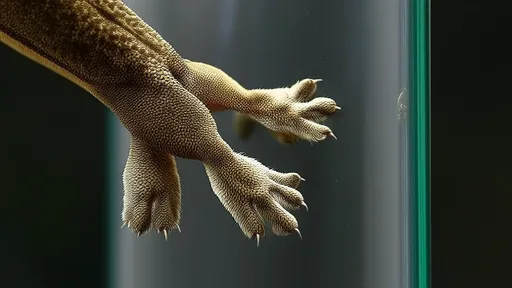
The foundation of a gecko's adhesive prowess begins at a scale invisible to the naked eye. Their toes are equipped with rows of tiny, leaf-like flaps called lamellae. Upon closer inspection, each lamella is densely packed with millions of hair-like structures known as setae. These setae, finer than a human hair, branch out into hundreds of even smaller, spatula-tipped endings. This hierarchical structure, from lamellae to setae to spatulae, creates an astronomical surface area for interaction at the molecular level, allowing the gecko to exploit a fundamental physical force.
The magic behind the adhesion is a quantum mechanical phenomenon known as van der Waals forces. These are weak electrostatic attractions that occur between molecules when they are brought into extremely close proximity. While individually insignificant, the collective strength of billions of these interactions across the vast surface area of the spatulae creates a powerful and reliable adhesive force. This mechanism is entirely physical and dry, requiring no glue, no suction, and no expenditure of energy from the animal to maintain its grip. It is a passive, yet incredibly effective, system.
Perhaps even more remarkable than the gecko's ability to stick is its ability to unstick with effortless speed. If the adhesion were permanent, the gecko would be forever anchored to the first surface it touched. The secret to release lies in the angle of attachment. The setae are designed to engage and generate strong van der Waals forces when pulled in a specific direction—down and towards the body. To detach, the gecko simply changes the angle of its toe, peeling it away from the surface much like removing a piece of tape. This directional adhesion allows for a rapid, controlled, and energy-efficient gait, even when upside down.
The potential applications inspired by gecko adhesion are as vast as they are revolutionary. In the realm of robotics, researchers are developing soft, agile robots capable of climbing smooth surfaces for search-and-rescue missions in collapsed buildings or for performing inspections and repairs on difficult-to-reach infrastructure like wind turbines and spacecraft exteriors. The field of medicine is exploring dry, reusable gecko-inspired adhesives for wound closure and surgical tapes that are strong yet gentle on sensitive tissues.
Beyond robotics and medicine, this bio-inspired technology promises innovations in everyday life. Imagine super-grip tires for vehicles operating in challenging environments, or advanced sporting equipment with enhanced handling. In manufacturing and warehousing, gecko-grip technology could lead to new types of manipulator arms that can handle fragile, smooth objects like glass panels or silicon wafers without scratching or dropping them, all without leaving a residue.
Despite significant progress, replicating the gecko's sophisticated system presents immense challenges. Engineering a synthetic material that boasts millions of microscopic, flexible hairs, each capable of conforming to nanoscale surface irregularities without matting or wearing out, is a formidable task. Current research is focused on developing durable, self-cleaning polymers that can mimic the gecko's ability to shake off dirt and maintain its stickiness over thousands of cycles, a necessary step for practical, long-term use.
The humble gecko's foot is a profound testament to the power of evolution and a masterclass in nanoscale engineering. It demonstrates that overwhelming strength does not always require brute force but can be achieved through the subtle, cumulative effect of countless tiny interactions. As scientists continue to decode and emulate this biological blueprint, the line between science fiction and reality continues to blur, promising a future where we can walk, climb, and grasp in ways once reserved for the pages of comic books, all thanks to the lessons learned from a lizard on the wall.

By /Aug 21, 2025

By /Aug 21, 2025
By /Aug 21, 2025

By /Aug 21, 2025
By /Aug 21, 2025
By /Aug 21, 2025

By /Aug 21, 2025
By /Aug 21, 2025

By /Aug 21, 2025
By /Aug 21, 2025
By /Aug 21, 2025
By /Aug 21, 2025

By /Aug 21, 2025

By /Aug 21, 2025
By /Aug 21, 2025
By /Aug 21, 2025
By /Aug 21, 2025
By /Aug 21, 2025
By /Aug 21, 2025
By /Aug 21, 2025
