In the vast, frozen expanse of Antarctica, where survival is a daily battle against the elements, a remarkable social structure thrives among the emperor penguins. This is the story of their crèches, the Antarctic kindergartens that represent one of the most sophisticated and vital collective childcare systems in the animal kingdom. Far from a simple gathering of chicks, these nurseries are a complex, instinct-driven strategy for species survival, a testament to evolutionary ingenuity in the planet's harshest environment.
The entire process begins not with the chicks, but with their parents. After the female lays her single, precious egg in the heart of the brutal Antarctic winter, she immediately transfers it to the top of the male's feet, covering it with a warm fold of skin called the brood pouch. Her energy reserves depleted by laying the egg, she must immediately embark on a long, perilous journey to the open ocean to feed. This transfer is a delicate and critical maneuver; if the egg touches the ice for even a moment, the embryo will perish. The male is thus left alone, shouldering the immense responsibility of incubation for the next two months. He will eat nothing, braving hurricane-force winds and temperatures that plummet to -60°C (-76°F), surviving solely on his fat reserves. His sole focus is to keep the egg warm and alive, huddling with thousands of other males in a massive, rotating swarm to share warmth.
When the chicks finally hatch, they are utterly dependent. They are covered in a thin layer of down and are incapable of regulating their own body heat. For their first few weeks of life, they remain securely tucked within the father's brood pouch, receiving warmth and protection. During this time, the mothers begin to return from the sea, their bellies full of fish to regurgitate for the hungry newborn. The colony becomes a cacophony of calls as parents and chicks use unique vocal signatures to find one another amidst the thousands of identical-looking birds. This reunion is a precarious moment; if a mother is delayed or lost, the chick will starve, and if a father does not successfully find his mate, he will be forced to abandon his chick to save his own life, heading to sea to feed after his long fast.
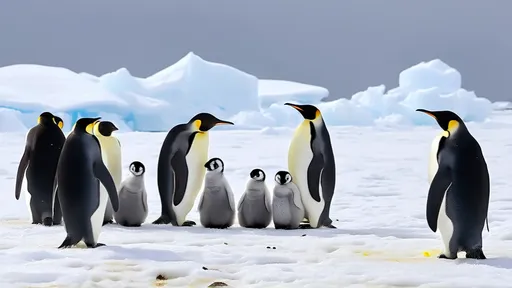
As the chicks grow older and their down becomes thicker, they become too large to fit entirely within the brood pouch. However, they are still highly vulnerable to the cold and to predators like the skua. This is the pivotal moment when the crèche begins to form. The chicks, driven by a powerful instinct, start to huddle together in small groups. These groups gradually coalesce into larger, more organized assemblies—the crèches. This behavior is not taught; it is an innate survival mechanism hardwired into their DNA. By grouping together, the chicks achieve what they cannot do alone: conserve body heat. The collective warmth generated within a tightly packed crèche is significant, allowing them to withstand the external cold far more effectively than any single chick could.
The formation of a crèche is not a sign of parental abandonment. Quite the opposite, it is a carefully coordinated strategy that frees up both parents to forage. While the chicks are safely ensconced in their huddle, the mother and father can now both make the journey to the sea to hunt. This dual foraging effort is essential to keep up with the ravenous appetite of a growing penguin chick. The parents take turns; one stays to guard the crèche while the other is away feeding. The "on-duty" parent does not necessarily watch over its own offspring but acts as a guardian for the entire group. They are fiercely protective, positioning themselves on the outskirts of the huddle, ever vigilant for aerial attacks from skuas. If a predator approaches, the adult will sound an alarm and use its beak and flippers to defend the chicks.
Life within the crèche is a dynamic and social experience for the chicks. They are not simply stationary lumps conserving heat. They move about, interacting with their crèche-mates, strengthening their legs, and developing the social bonds that will be crucial later in life. This period is a critical phase of development beyond mere thermoregulation. It is their first school, where they learn the nuances of penguin society. The crèche also serves as a clear landmark for returning parents. After weeks at sea, a parent arrives back at the colony and navigates the seemingly chaotic scene to locate the specific crèche where their chick is waiting. Once again, they rely on their unique call-and-response duet to find their one chick among hundreds.
The success of this collective nursery system is paramount for the emperor penguin. In an environment where the margin for error is zero, the crèche dramatically increases chick survival rates. It mitigates the risks of predation and hypothermia during the most vulnerable stage of their lives. This strategy allows the entire colony to produce a new generation efficiently. Without the crèche system, the energy demands on the parents would be unsustainable, and the species would likely falter in its extreme habitat. It is a beautiful, stark illustration of the proverb "it takes a village to raise a child," adapted for the Antarctic. The health of the entire colony is invested in the survival of every chick.
However, this intricate and ancient system now faces an unprecedented threat: climate change. Emperor penguins are uniquely adapted to a specific set of icy conditions. Their breeding cycle is perfectly timed so that the chicks fledge—growing their waterproof feathers and becoming independent—just as the sea ice begins to break up in the Antarctic summer. This provides them with easy access to the ocean. As global temperatures rise, sea ice is forming later and breaking up earlier. This de-synchronization is catastrophic. If the ice breaks up before the chicks have developed their insulating juvenile plumage, they will be forced into the frigid water and drown or freeze to death. Scientists are already observing entire colony failures linked to early ice breakup. The very foundation of their reproductive strategy is melting beneath their feet.
The emperor penguin's crèche is far more than a charming spectacle of fluffy chicks huddled together. It is the beating heart of their reproductive strategy, a sophisticated biological and social adaptation forged by millions of years of evolution. It is a system built on selflessness, incredible endurance, and profound cooperation. From the father's heroic fast to the mother's long journey, to the communal guarding and the chicks' own instinct to huddle, every element is perfectly calibrated for survival at the end of the Earth. Observing these kindergartens on ice is to witness one of nature's most resilient and collaborative efforts to perpetuate life against all odds. Their continued existence, however, hangs in a delicate balance, reliant on the stability of a world that is rapidly warming around them.
By /Aug 21, 2025
By /Aug 21, 2025
By /Aug 21, 2025
By /Aug 21, 2025
By /Aug 21, 2025
By /Aug 21, 2025

By /Aug 21, 2025

By /Aug 21, 2025

By /Aug 21, 2025
By /Aug 21, 2025
By /Aug 21, 2025

By /Aug 21, 2025
By /Aug 21, 2025

By /Aug 21, 2025
By /Aug 21, 2025
By /Aug 21, 2025
By /Aug 21, 2025
By /Aug 21, 2025
By /Aug 21, 2025
By /Aug 21, 2025
