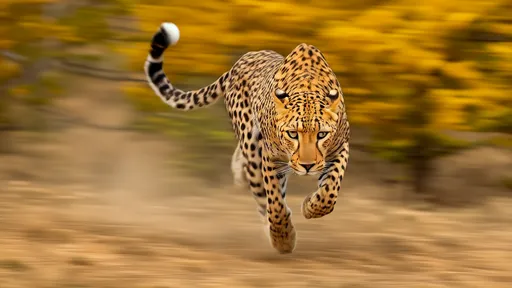
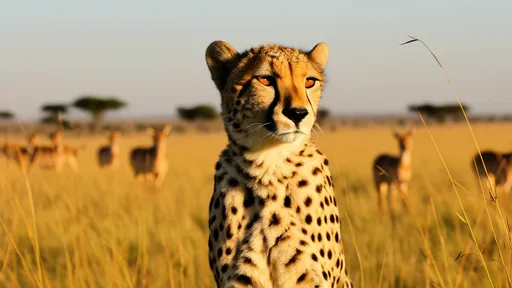
The African savannah holds many marvels, but few are as breathtaking as the raw, explosive acceleration of a hunting cheetah. In the span of a few heartbeats, this magnificent cat transforms from a statuesque observer into a blur of focused velocity, a testament to millions of years of evolutionary perfection. It is not merely fast; it is the fastest accelerator on land, a living projectile whose launch sequence is a biomechanical wonder.
This acceleration is not a simple matter of powerful legs. It is a symphony of specialized adaptations working in flawless harmony. The cheetah's lightweight skeleton, particularly its semi-retractable claws that act like sprinting cleats for unparalleled grip, provides the foundation. Its large nostrils and lungs hyper-oxygenate its blood in those critical first seconds, while its long, muscular tail acts as a crucial rudder for stability during high-speed maneuvers. Every aspect of its physiology, from the flexibility of its spine that acts like a spring to the unique ratio of fast-twitch muscle fibers, is engineered for one purpose: to go from zero to top speed in the time it takes you to read this sentence.
The launch itself is a spectacle of controlled chaos. Crouched low, the cheetah's hind limbs coil like immense springs, storing potential energy. In an instant, this energy is unleashed in a powerful extension, propelling the animal forward. Its spine flexes and extends with each stride, adding significant length and power, effectively making each bound cover more ground than its leg length would suggest possible. This is not running; it is a series of controlled, explosive leaps, each one a testament to the immense G-forces its body is built to withstand.
However, this incredible power comes at a steep cost. The cheetah's body is a furnace burning fuel at an unsustainable rate. The immense energy expenditure and the heat generated during a sprint mean its hunting strategy is one of precision and short duration. A chase lasting more than twenty to thirty seconds risks catastrophic overheating and exhaustion, leaving the animal vulnerable. This is why the stalk is so critical; the acceleration must be perfectly timed and directed. It is a gamble of energy reserves where a miss can mean starvation.
Furthermore, the very adaptations that make it the ultimate sprinter render it comparatively fragile in the harsh ecosystem it inhabits. Its light frame, lacking the heavy bone and muscle mass of a leopard or lion, makes it ill-suited for confrontation. A cheetah must often abandon its hard-won meal to more robust predators, a heartbreakingly common occurrence that underscores the delicate balance of its existence. Its speed is both its greatest weapon and its greatest vulnerability.
Observing a cheetah hunt is to witness evolution's answer to a very specific problem. It did not evolve to be the endurance runner; that title belongs to the African wild dog. It did not evolve to be the strongest; that is the domain of the big cats. It evolved for one singular, spectacular purpose: to be the undisputed master of the initial pursuit. In the economy of the savannah, the cheetah occupies the niche of the lightning strike—brief, devastating, and over almost as soon as it has begun.
Conservation efforts are now critical to preserving this acceleration miracle. Habitat loss, human-wildlife conflict, and a fragile genetic pool threaten its future. Understanding the cheetah is not just about marveling at its speed; it is about appreciating the intricate and precarious design of a creature that has perfected a single, extraordinary skill to survive. Protecting the cheetah means safeguarding a unique chapter in the story of life on Earth, a chapter written in velocity and grace.

By /Aug 21, 2025
By /Aug 21, 2025

By /Aug 21, 2025
By /Aug 21, 2025
By /Aug 21, 2025
By /Aug 21, 2025

By /Aug 21, 2025
By /Aug 21, 2025

By /Aug 21, 2025
By /Aug 21, 2025
By /Aug 21, 2025

By /Aug 21, 2025

By /Aug 21, 2025

By /Aug 21, 2025
By /Aug 21, 2025
By /Aug 21, 2025
By /Aug 21, 2025
By /Aug 21, 2025
By /Aug 21, 2025
By /Aug 21, 2025
