The ancient temples of Thailand stand as silent witnesses to centuries of spiritual devotion, artistic brilliance, and cultural evolution. These sacred structures, scattered across bustling cities and serene countryside alike, offer more than just a glimpse into the nation’s religious practices—they are living embodiments of Thai identity. From the gilded spires of Bangkok’s Grand Palace complex to the crumbling ruins of Ayutthaya, each temple tells a story woven with threads of history, mythology, and craftsmanship.
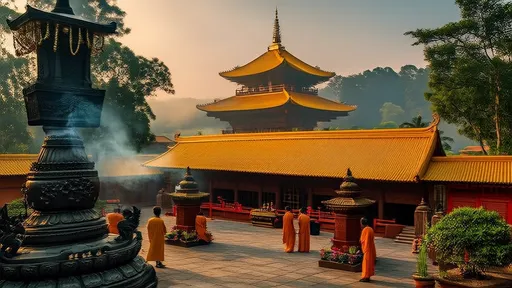
Stepping into a Thai temple, or wat, is an assault on the senses in the most enchanting way possible. The air hangs heavy with the scent of jasmine incense and lotus blossoms, while the distant murmur of monks chanting in Pali creates a rhythm that feels both foreign and familiar. Golden Buddha statues, some towering several stories high, gaze down with serene indifference, their expressions frozen in a state of perfect enlightenment. The walls whisper tales through intricate murals depicting everything from the Buddha’s previous lives to scenes from the Hindu epic Ramayana, revealing Thailand’s unique syncretism of Theravada Buddhism and animist traditions.
What many visitors fail to realize is that Thai temples are not mere tourist attractions but functioning centers of community life. At dawn, saffron-robed monks emerge from their quarters to collect alms—a practice unchanged for over 800 years. Locals kneel to offer sticky rice and curries, earning merit for their next life while sustaining the monastic community. Schoolchildren in crisp uniforms giggle as they light incense before exams, and elderly women whisper prayers while circling the main chedi (stupa) with lotus buds in hand. This seamless integration of the sacred and mundane makes Thai Buddhism remarkably accessible compared to the more austere traditions found elsewhere in Asia.
The architectural diversity among Thailand’s temples reflects the nation’s complex historical tapestry. Sukhothai-era wats, like those at Si Satchanalai, showcase the elegant lotus-bud chedis that would become Thailand’s architectural signature. Ayutthaya’s laterite ruins bear scars from Burmese invasions but still reveal Khmer influences in their prang towers. Bangkok’s Wat Pho astonishes with its gargantuan reclining Buddha and traditional medical school, while Chiang Mai’s Wat Phra That Doi Suthep glitters atop misty mountains like a celestial city. Even modern constructions like Wat Rong Khun (the White Temple) challenge conventions with their surreal, mirror-clad designs that incorporate pop culture references alongside traditional Buddhist iconography.
Behind the glittering facades lies an intricate world of symbolism. The multi-tiered roofs represent Mount Meru, the cosmic center of Buddhist and Hindu cosmology. Naga serpent balustrades guard stairways, symbolizing the protector of the Buddha. Even the colors hold meaning—gold for enlightenment, white for purity, and the rare blue seen at Wat Benchamabophit representing the Buddha’s victory over temptation. Every inch of these complexes, from the carved wooden gables to the mother-of-pearl inlaid doors, serves as a three-dimensional teaching of Dhamma principles.
Preservation efforts face constant challenges from urbanization, pollution, and even well-meaning but misguided restoration attempts. The 2014 earthquake that damaged several Chiang Rai temples highlighted vulnerabilities in ancient construction techniques. Yet there’s hope in projects like the Fine Arts Department’s use of drone mapping to document temple architecture, or local initiatives training young artisans in traditional stucco work and gold leaf application. As Thailand navigates modernity, its temples remain both anchors to the past and compasses pointing toward cultural continuity.
For travelers seeking more than Instagram backdrops, temple visits offer profound lessons in contemplative living. Participating in a monk chat program at Wat Chedi Luang, joining a meditation retreat at Wat Suan Mokkh, or simply observing the daily rituals can transform these sites from photogenic curiosities into portals for cross-cultural understanding. The true magic of Thai temples lies not in their gold leaf or elaborate carvings, but in their ability to make the intangible tangible—to give form to a philosophy that values impermanence, to materialize serenity in a chaotic world, and to remind all who enter that enlightenment might just be a quiet moment away.
By /Aug 13, 2025

By /Aug 13, 2025
By /Aug 13, 2025
By /Aug 13, 2025
By /Aug 13, 2025

By /Aug 13, 2025

By /Aug 13, 2025
By /Aug 13, 2025
By /Aug 13, 2025

By /Aug 13, 2025

By /Aug 13, 2025
By /Aug 13, 2025

By /Aug 13, 2025

By /Aug 13, 2025

By /Aug 13, 2025
By /Aug 13, 2025

By /Aug 13, 2025

By /Aug 13, 2025
By /Aug 13, 2025

By /Aug 13, 2025
