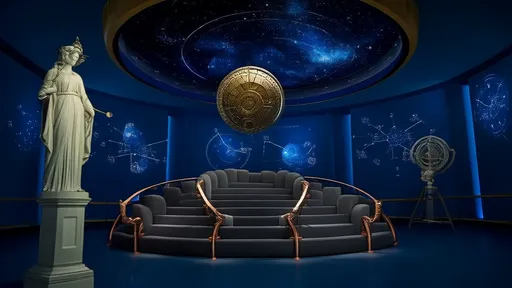
The soft glow of distant stars casts an ethereal light across the domed ceiling, as visitors tilt their heads upward in quiet wonder. Planetariums have long served as gateways to the cosmos, bridging the gap between terrestrial life and the vast unknown. These celestial theaters are more than just buildings—they are portals to other worlds, classrooms without walls, and sanctuaries for the imagination. Unlike traditional museums, where artifacts sit static behind glass, planetariums pulse with life, their narratives unfolding across curved screens in a symphony of light and motion.
At the heart of every great planetarium lies its optical star projector—a mechanical marvel that replicates the night sky with astonishing precision. Modern hybrid systems blend these analog projectors with digital fulldome video, allowing audiences to zoom through nebulae or witness supernovae from impossible angles. The technology has evolved dramatically since Walther Bauersfeld first conceived the idea for Carl Zeiss AG in 1923, yet the fundamental magic remains unchanged. When the house lights dim and the artificial heavens appear, even seasoned astronomers report feeling that familiar childhood thrill of cosmic discovery.
The programming offered by contemporary planetariums reveals their dual identity as both educational institutions and entertainment venues. Morning shows for school groups might explore Newtonian physics through animated asteroid collisions, while evening performances set planetary motion to Pink Floyd's Dark Side of the Moon. Cutting-edge facilities employ 8K resolution and 7.1 surround sound to simulate interstellar travel so visceral that visitors instinctively grip their armrests during "launch." Some institutions have even begun incorporating live telescope feeds, turning their domes into real-time windows on the universe.
Architecturally, planetariums often embody the celestial themes they present. The Nagoya City Science Museum boasts the world's largest dome at 35 meters in diameter—a silver sphere resembling a crashed UFO. In contrast, Stockholm's Cosmonova utilizes a brutalist concrete exterior that gives way to an intimate, womb-like interior. These structures frequently become civic landmarks, their distinctive silhouettes appearing on city skylines like secular cathedrals to space exploration. The very act of entering their circular halls prepares visitors for the extraordinary experience within.
Beyond public shows, planetariums serve as vital research tools. Many collaborate with universities to visualize complex astrophysical data, helping scientists detect patterns in galactic formations or exoplanet orbits. The American Museum of Natural History's Hayden Planetarium played a crucial role in developing the first 3D atlas of the universe—a digital map now used by researchers worldwide. This symbiosis between public education and academic research creates a feedback loop where cutting-edge discoveries quickly find their way into popular programming.
The social role of planetariums has expanded significantly in recent decades. Once considered niche attractions for astronomy enthusiasts, they now address pressing global issues through immersive storytelling. Climate change presentations overlay atmospheric data onto rotating Earth models, while light pollution shows demonstrate how urban glow obscures our view of the Milky Way. Some institutions have developed specialized programs for visitors with autism or visual impairments, using tactile models and adaptive audio descriptions. These efforts reflect a growing recognition that access to cosmic perspective shouldn't be limited by circumstance.
Financially, planetariums walk a tightrope between scientific rigor and mass appeal. Ticket sales rarely cover operational costs, leaving many dependent on philanthropic support or government funding. This economic reality sometimes sparks debate about content balance—should shows prioritize factual accuracy or spectacle? The most successful institutions manage both, like the California Academy of Sciences' planetarium which pairs PhD-verified scripts with Hollywood-grade production values. Their approach proves that scientific integrity needn't come at the expense of entertainment.
Looking ahead, emerging technologies promise to further transform the planetarium experience. Augmented reality headsets may soon allow visitors to "grab" virtual planets with their hands, while haptic flooring could simulate walking on Martian regolith. Advances in AI might enable real-time Q&A sessions with virtual astrophysicists during shows. Yet even as these innovations arrive, the core mission remains: to remind earthbound audiences that we're all passengers on a pale blue dot, hurtling through an astonishingly vast and beautiful universe.
The true power of planetariums lies not in their technology or architecture, but in their ability to rekindle our innate sense of wonder. In an age of smartphone distractions and shortened attention spans, these spaces command us to sit still and contemplate our place in the cosmos. They reconnect us with ancient human traditions—our ancestors also gathered beneath domed ceilings (whether cave or cathedral) to ponder the heavens. As light pollution increasingly severs modern populations from direct stargazing, planetariums become ever more crucial as places where the night sky can still be seen in all its glory, where children point excitedly at Saturn's rings, and where adults remember how small—and how precious—our world truly is.

By /Aug 13, 2025

By /Aug 13, 2025

By /Aug 13, 2025

By /Aug 13, 2025

By /Aug 13, 2025

By /Aug 13, 2025

By /Aug 13, 2025

By /Aug 13, 2025

By /Aug 13, 2025

By /Aug 13, 2025

By /Aug 13, 2025

By /Aug 13, 2025

By /Aug 13, 2025

By /Aug 13, 2025

By /Aug 13, 2025

By /Aug 13, 2025

By /Aug 13, 2025

By /Aug 13, 2025
By /Aug 13, 2025

By /Aug 13, 2025
